Sharks are the thing people ask about before a Red Sea trip. Usually in a nervous, half-joking way. Here is the honest answer, without the brochure gloss or the scare tactics.
- How dangerous is the Red Sea, really?
- Who actually gets bitten in the Red Sea
- Which sharks are actually behind Red Sea attacks
- Why great whites avoid the Red Sea
- Why whitetips reach Egypt’s shore
- How Red Sea sharks bite
- Where Red Sea attacks happen, and where they don’t (yet)
- Why Egypt’s attacks are more often fatal
- How Red Sea beaches are protected, and how they aren’t
- So can you actually avoid a Red Sea shark attack?
- What the Red Sea shark record actually says
- Sources behind these Red Sea shark numbers
- Read more
Attacks are rare. Most years there are none at all. But they are real, and some have been fatal, including a young man killed at a busy Hurghada beach in 2023. Pretending otherwise helps nobody.
So this is what the actual record shows. Which sharks are involved, where incidents happen, why they turn deadly, and what genuinely lowers your risk versus what is just comforting noise. I dug through the case data instead of repeating the usual safety-poster lines. Some of it will surprise you, and some is simply luck, which I will say plainly when it is.
How dangerous is the Red Sea, really?
Let us start with scale, because fear runs ahead of facts here. Egypt has roughly 53 recorded shark attacks going back to the 1800s, and 17 of them were fatal. Spread across nearly 2 centuries and millions of swimmers a year, that is a very small number.
The pattern matters more than the total. Attacks do not trickle in steadily. They arrive in rare clusters, often several within days at a single spot, then nothing for years. As of now, no attacks have been reported in Egypt during 2026.
Here is the honest headline before we go deeper:
- Recorded attacks are rare and tend to come in short bursts, not as a constant background risk.
- Egypt has seen about 53 recorded attacks since the 1800s, 17 of them fatal.
- The fatality rate, close to 32 percent, runs noticeably higher than the global average near 21 percent. More on why later.
- Millions of people swim, snorkel, and dive the Red Sea every year without any incident at all.
None of that makes the risk zero. It makes it small, uneven, and worth understanding rather than panicking over.
Who actually gets bitten in the Red Sea
There is a belief I hear constantly, and it is backwards. People say, “I only snorkel, I don’t dive, so sharks aren’t really my problem.” The data says the opposite.
Worldwide, the people bitten are overwhelmingly at the surface. Swimmers, surfers, and snorkelers make up the large majority of cases. Scuba divers, down below and breathing bubbles, are a small slice, around 4 percent in a typical year, and in some years the count is zero.
Egypt’s own record tells the same story with a local twist.
| Activity (Egypt’s recorded attacks) | Approximate cases |
|---|---|
| Snorkeling | 14 |
| Swimming | 9 |
| Scuba diving | 6 |
| Bathing in the shallows | 2 |
| Fishing | 2 |
Snorkeling sits at the top. That is the whole point: being at the surface is the risk factor, and snorkeling is a surface activity. The takeaway is not that diving is safe and snorkeling is not. It is that “I only snorkel” is not the shield people think it is.
The local twist is scuba. Globally, divers are rarely bitten, but Egypt has 6 recorded cases, more than the global pattern predicts. That is because Egypt’s famous offshore dive sites are exactly where oceanic whitetips gather. So here, divers are not off the menu the way they are elsewhere.
Which sharks are actually behind Red Sea attacks
Forget the Latin names and the single scary silhouette everyone pictures. Only a few species are involved in Red Sea incidents, and the small reef sharks you are most likely to actually see are not among them.
| Shark | Where you might meet it | How it behaves around people |
|---|---|---|
| Oceanic whitetip | Deep water and offshore reefs, rarely near shore | Bold, curious, persistent; the recurring species in attacks |
| Tiger shark | Warm coastal and open water | Indiscriminate feeder; powerful, slow to back off |
| Mako | Fast open water | Rarely encountered; involved in a few cases |
| Reef sharks | On and around the coral, in the shallows | Shy and harmless; what you will usually see |
The recurring troublemaker is the oceanic whitetip, an open-water shark. Tiger sharks and makos account for most of the rest. The reef sharks patrolling the coral, blacktips, greys, and whitetip reef sharks, generally want nothing to do with you.
Here is what sets the dangerous few apart, and why the reassuring shark clichés do not apply to them.
Why great whites avoid the Red Sea
Here is the reassuring part, and it is true. The shark most people actually picture, the great white of every movie and nightmare, is effectively not here. In 2 centuries of Egyptian records there is a single “white shark” entry, and species identification in old reports is notoriously shaky.
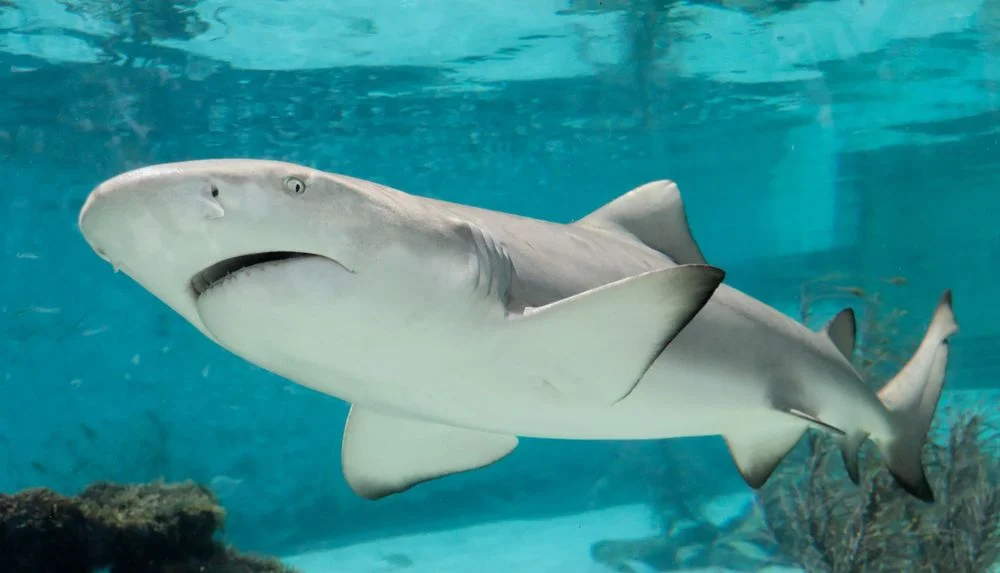
The reason is temperature. Great whites prefer cooler water, and to reach the Red Sea they would have to cross the very warm Arabian Sea, which stays too hot for them. So the specific monster in your head is not the one in this sea. That does not make the water risk-free, but it does move the fear to the right animal.
Why whitetips reach Egypt’s shore
The oceanic whitetip is an open-ocean animal. It lives far offshore, and its numbers actually rise the further you get from land. It is bold, wide-ranging, and quick to investigate anything unusual, because the open sea is a food desert and it cannot afford to be picky.
That reputation is old and grim. It is the shark most associated with reaching survivors after ships sink far out at sea. Jacques Cousteau called the oceanic whitetip “the most dangerous of all sharks.”
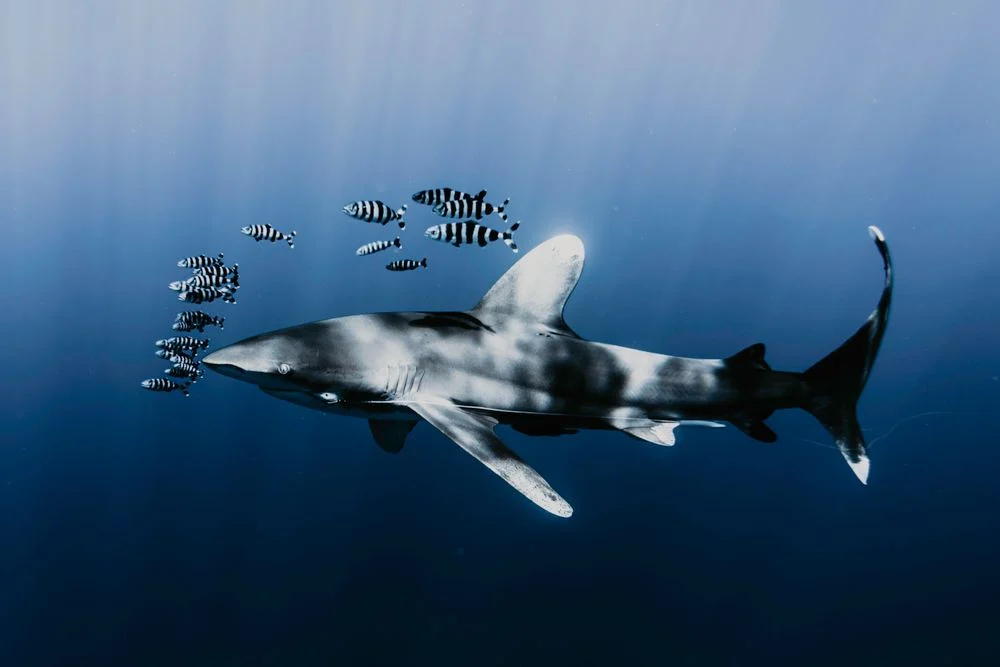
So why does a deep-ocean shark ever end up at a beach? Because the Red Sea is unusual. Its deep water sits close to the coast, which means the whitetip’s real habitat is never far from where people swim. That geography is the whole story, and it is the next section.
How Red Sea sharks bite
There is a comforting idea that circulates: a shark bites once, realizes its mistake, and swims off. That is a great white story, and it does not describe the sharks in this sea.
Great whites hunt fatty seals. When one bites a person, it often lets go almost immediately, because a lean human is the wrong meal. Deaths happen through blood loss, not appetite.
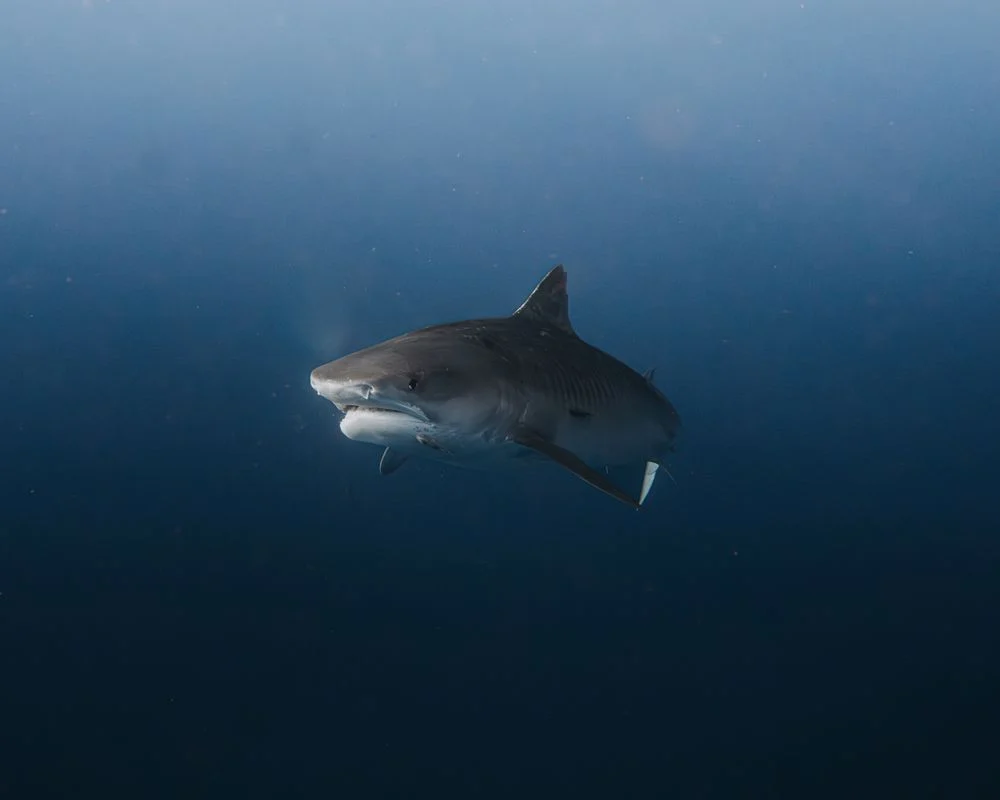
Tiger sharks and oceanic whitetips are different: indiscriminate feeders with no built-in reason to reject a person as prey. Most of their bites are still a single investigative one. But when an attack does turn predatory, these species are far less likely to simply back away. That is the honest reason the “it will let go” reassurance should not travel to Egypt.
Where Red Sea attacks happen, and where they don’t (yet)
Plot the recorded incidents on a map and a shape appears. Attacks concentrate at the 3 big resort regions: Sharm el-Sheikh and Ras Mohammed at the tip of Sinai, Hurghada and Sahl Hasheesh on the mainland coast, and Marsa Alam farther south. That is partly just where the swimmers are.
One honest caveat before you read the pins. Several of Egypt’s recorded attacks are logged at Port Said, which sits on the Mediterranean at the mouth of the Suez Canal, not on the Red Sea at all.
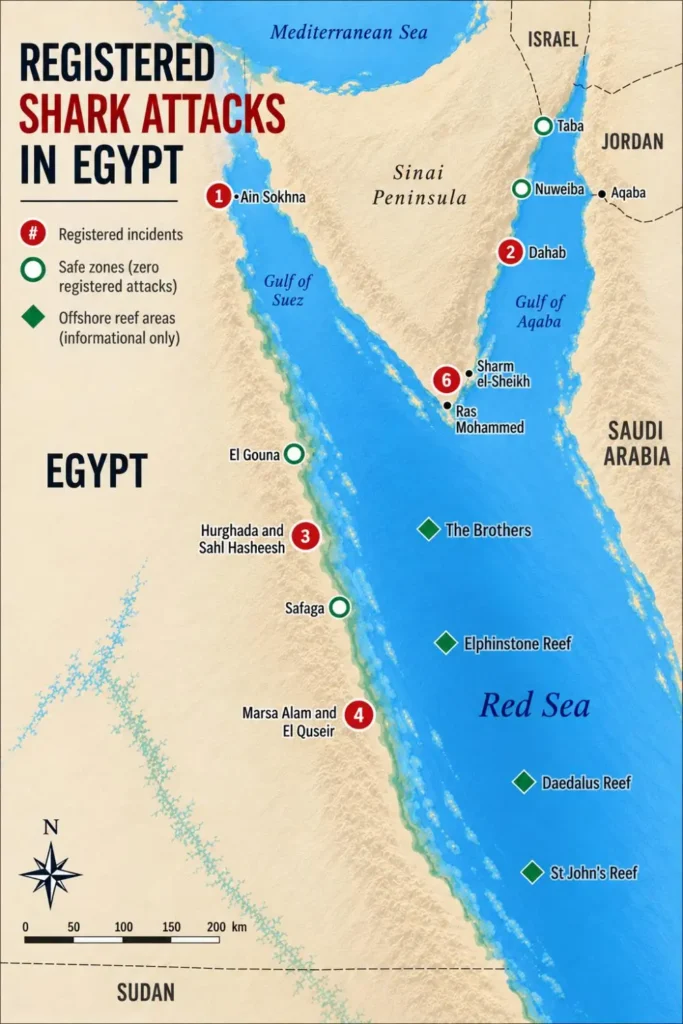
Here is how the recorded incidents break down by area:
- Sharm el-Sheikh and Ras Mohammed: about 6 recorded incidents, including the 2010 cluster.
- Marsa Alam and El Quseir: about 4, spread across several nearby spots.
- Hurghada and Sahl Hasheesh: 3, all fatal.
- Dahab, on the Gulf of Aqaba: 2.
- Ain Sokhna, in the Gulf of Suez: 1.
- Nuweiba and Taba, on the northern Gulf of Aqaba: none in this record.
- El Gouna and Safaga, just outside the Hurghada cluster: none in this record.
The green diamonds on the map matter as much as the red circles. They mark the offshore deep reefs, the Brothers, Elphinstone, Daedalus, and St John’s, where oceanic whitetips actually live. In the Red Sea those reefs sit only a short hop offshore, because the seabed drops to great depth close to the coast. An open-ocean shark can reach a beach here in a way it never could on a wide, shallow coastline.
So can I hand you a list of safe beaches? Not honestly, but the record does have real gaps worth knowing. The northern Gulf of Aqaba is the clearest example: Sharm at the Sinai tip has about 6 incidents, Dahab has 2, and Nuweiba and Taba further north have none on record at all. El Gouna and Safaga, just outside the Hurghada cluster, are also clean in the record, though both get closed whenever Hurghada is hit, so that is adjacency, not safety.
Here is the catch that keeps all of this honest. A thin record usually means fewer swimmers, not fewer sharks. The far southern coast near Berenice barely appears in any attack log, yet tour operators avoid its waters because of the size and boldness of the sharks there. With no net or barrier anywhere on this coast, no spot is guaranteed, only places where the record happens to be quiet.
Why Egypt’s attacks are more often fatal
Egypt’s fatality rate is the uncomfortable outlier. Close to 32 % of its recorded attacks were fatal, against a global average near 21 %. The natural assumption is that Egyptian sharks bite harder. The data does not support that.
Start with species. Here is roughly how deadly the main species are worldwide.
| Species | Rough fatality rate |
|---|---|
| Great white | ~17% |
| Oceanic whitetip | ~20% (documented) |
| Bull | ~22% |
| Tiger | ~27% |
Blend Egypt’s mix, mostly whitetip with some tiger, and you would predict something in the low-to-mid 20s percent, not 32. So the severity of the animal is not the answer. Something else is lifting the number.
The best-supported explanation is context. Egypt’s fatal attacks happen in deep, open water, far from a boat, while the victim is at the surface. Shark-bite deaths are almost always bleed-outs, and survival depends on stopping the bleeding within minutes. When a person is hundreds of meters out over deep water, help and a tourniquet are simply too far away.
A 200-year Australian study found that having a boat for flotation and a fast exit raised survival for tiger shark bites to 92 percent, against 30 percent without it. Distance and time, not the shark’s jaws, often decide the outcome.
Could responder skill and medical access also play a part? Plausibly, yes, and it is worth naming. But the incident databases record species, activity, and outcome, not response times or cause of death, so that specific claim cannot be proven from the data, and it tangles with the deep-water distance problem. There is also a small-sample caveat. 53 cases and 17 deaths is thin, and if minor bites go unrecorded more often than serious ones, the fatal share looks higher than it truly is.
How Red Sea beaches are protected, and how they aren’t
This is the single most useful thing most travelers do not know walking in, and it reframes every safety tip. The protection you might unconsciously expect is not the protection Egypt uses.
In Australia and South Africa, many popular beaches are actively managed with nets, drumlines, drone patrols, and shark-spotting programs, backed by professional lifeguards and fast trauma care. The record at those specific beaches is strong. Queensland, for example, has had a single fatality on a controlled beach since 1962.
Egypt uses none of that. There are no shark nets, drumlines, or drone-alert systems on the Red Sea, partly because the coral reefs and deep drop-offs make netting impractical and destructive.
| Netted beaches (Australia, South Africa) | Red Sea resort beaches (Egypt) | |
|---|---|---|
| Barrier or culling | Nets and drumlines cut shark numbers in the area | None |
| Surveillance | Drones, spotters, tagged-shark alerts | Watchtowers and lifeguard observation |
| Swimming zone | Often behind a physical barrier | Marked by floating buoys, not a fence |
| Safety model | Prevent and screen beforehand | React and close after a sighting |
What Egypt does have, mostly mandated only after the recent wave of attacks, is a reactive model: buoys marking where deep water starts, watchtowers, certified lifeguards, rescue boats, and quick temporary closures after any sighting. Managed resort beaches at Sharm, Hurghada, and Marsa Alam do run marked zones with lifeguards and daily monitoring.
The key is the nature of it. The marked line is information, not a fence, and nothing physically stops a shark from crossing it. Coverage and lifeguard quality vary by resort, and outside managed resort stretches there is often nothing at all. That thinner, later response is also consistent with the higher fatality rate, without blaming anyone: the environment forbids nets, so the system is built to react rather than prevent.
So can you actually avoid a Red Sea shark attack?
Time for the honest reckoning, the part most articles dress up, and I will not. You can lower your odds, but you cannot control the biggest variables, and anyone selling you a tidy checklist is selling comfort.
Why a shark comes inshore on a given day is genuinely unknown. Theories exist, dumped animal carcasses, illegal fish-feeding, overfishing pushing sharks toward the coast, but none is proven for any single attack, so I will not hand you one as fact. The popular “avoid dawn and dusk” line is contradicted by the actual cases here, several of which happened in bright daylight, at midday and in the afternoon.
What does hold up is smaller than people want. Treat every beach closure and marked swimming zone as seriously as a physical wall, because on this coast that is the only protection there is. When authorities close the water after a sighting, they are flagging a real, present danger. In 2010, a Sharm beach reopened and a swimmer was killed the very next day.
The one rule the data actually backs: obey closures and stay inside the marked zone, every single time. Beyond that, the timing and depth of past attacks were unpredictable, so a large part of it is simply luck, and no jewelry-and-dawn checklist changes that.
What the Red Sea shark record actually says
So where does that leave you? The honest summary is short. Red Sea shark attacks are rare but real, and sometimes fatal. The danger sits at the surface, so “I only snorkel” is not the shield people assume.
The sharks here are not the great white you picture, but they also do not follow the polite “one bite and gone” script. Protection is reactive, not physical, so the marked zone and the closure notice are the whole safety net. And a real share of the rest, honestly, comes down to luck.
That is the picture the data actually paints. What you do with it is up to you.
2 things the record clearly rewards: respect every closure, and remember that staying out of the water is the only certainty. Everything else is odds, not guarantees.
Sources behind these Red Sea shark numbers
Almost every figure here comes from a small set of authoritative places, so you can check any of them yourself:
- International Shark Attack File, Florida Museum of Natural History, University of Florida: global data on which species bite, what victims were doing, and how often bites are fatal. https://www.floridamuseum.ufl.edu/shark-attacks/
- Global Shark Attack File, Shark Research Institute: the case-by-case record of Egyptian incidents, including locations, activities, and outcomes. https://www.sharks.org/
- IUCN Red List, Oceanic Whitetip Shark (Carcharhinus longimanus): the species’ open-ocean range, surface preference, and critically endangered status. https://www.iucnredlist.org/species/39374/2911619
- Ryan et al., “A shark’s eye view,” Journal of the Royal Society Interface (2021): how sharks perceive swimmers and surfers at the surface. https://royalsocietypublishing.org/doi/10.1098/rsif.2021.0533
- “Increased shark bite survivability revealed by two centuries of Australian records,” Scientific Reports (2022): the survival data showing how much flotation and fast rescue change the odds. https://www.nature.com/articles/s41598-022-16950-5
- KwaZulu-Natal Sharks Board: how netted and drumlined beaches in South Africa and Australia are managed, and their safety record. https://shark.co.za/
- Egyptian Ministry of Environment, Red Sea swimming-safety instructions (reported by Egypt Independent): the marked zones, watchtowers, and lifeguard rules now in force. https://www.egyptindependent.com/egypt-issues-strict-warnings-and-instructions-to-protect-vacationers-from-shark-attacks/
One honest caveat on the totals. Different databases count differently, so Egypt’s tally ranges from about 18 unprovoked bites in the strictest reckoning to roughly 53 across all recorded incidents. I have used the broader figure throughout and treated it as recorded, not definitive.