The concept of the Seven Wonders of the World was probably the first travel bucket list ever invented. Most of us learned about the Seven Wonders of the Ancient World in school. They showed up in a textbook, we memorized the names, and then we moved on. But here’s the thing nobody told us back then: you can actually visit most of them. Not all of them, and not all in their full glory, but the sites exist. The stories are still in the ground.
- 1. The Great Pyramid of Giza, Egypt: The Only One Still Standing
- 2. Hanging Gardens of Babylon, Iraq
- Traveling to Iraq Today
- Alternative: Ancient Garden Sites in the Middle East
- 3. Statue of Zeus at Olympia, Greece
- 4. Temple of Artemis at Ephesus, Turkey
- 5. Mausoleum at Halicarnassus, Turkey
- Visiting the Mausoleum at Halicarnassus Today
- 6. Colossus of Rhodes, Greece
- 7. Lighthouse of Alexandria, Egypt
- Documentaries to watch on the 7 Ancient Wonders of the World:
- Read more
6 of the seven original wonders are gone. One still stands. And across Egypt, Greece, Turkey, and Iraq, there are ruins, foundations, underwater blocks, and museum halls that hold what’s left. This guide walks through each one, what you’ll actually find when you get there, and how to make the visit worth it.
1. The Great Pyramid of Giza, Egypt: The Only One Still Standing
The Great Pyramid of Giza is the only ancient wonder still largely intact. That’s not a small distinction. While the other six have crumbled, flooded, burned, or simply vanished, the pyramid has been standing for over 4,500 years and isn’t going anywhere soon. It’s the oldest of the seven wonders, and the last one surviving, which makes standing at its base feel a little different than any other ruin.
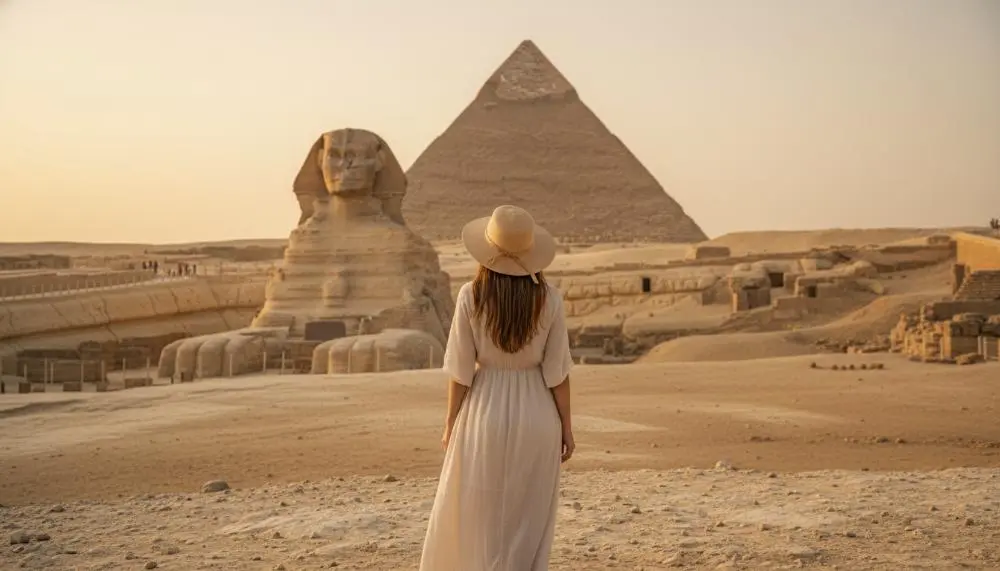
Being a tomb for Pharaoh Khufu around 2560 BCE, it stands as a testament to the craftsmanship of the ancient Egyptians. Its precise alignment with cardinal points and colossal stone blocks leaves visitors marveling at the mysteries of its construction. The accuracy of the construction spanned many myths as to the alien origin of the pyramids.
However, recent studies have uncovered an almost extinct Nile branch, providing a very credible theory for the pyramid construction. The Giza Plateau is home to 3 major pyramids and several smaller structures. These pyramids are among the most iconic and well-preserved structures from ancient Egypt.
Definitely, the pyramids are far from being the only thing that Egypt can offer. Red Sea diving, Muslim and Christian historic sites, ancient artifacts, natural masterpieces, and a lot more.
2. Hanging Gardens of Babylon, Iraq
The gardens were traditionally attributed to Nebuchadnezzar II, who supposedly built them as a gift for his wife, Amytis of Media, who missed the green hills of her homeland. According to classical texts, they were a series of ascending terraces, like a man-made mountain covered in trees and plants. The problem is that no Babylonian records mention them at all.
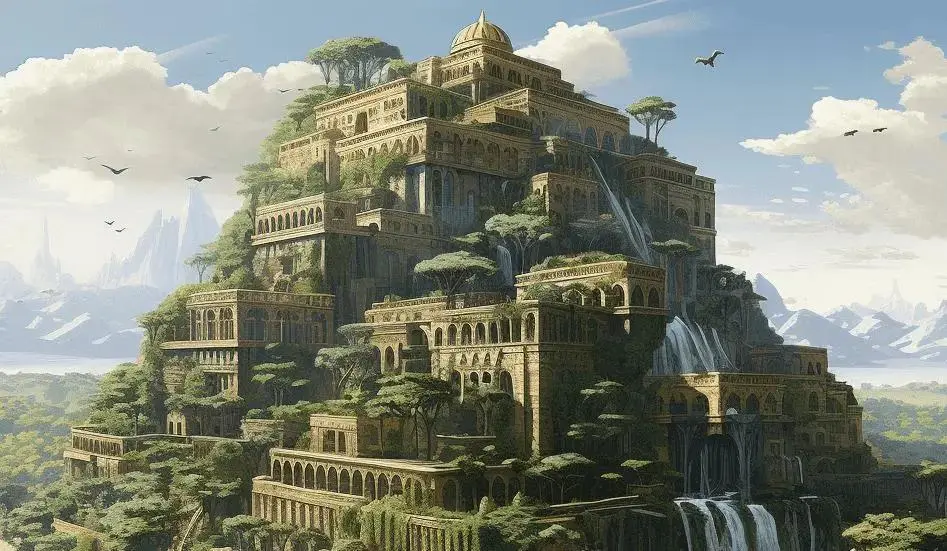
Oxford researcher Stephanie Dalley has argued for years that the gardens may not have been in Babylon at all, but in Nineveh, the capital of the Assyrian King Sennacherib.
Excavations at Nineveh have uncovered aqueduct systems, including the Jerwan aqueduct built from over 2,000,000 dressed stones, along with palace reliefs showing terraced gardens. Sennacherib left detailed inscriptions describing bronze water-raising screws that predate Archimedes by centuries.
Traveling to Iraq Today
Iraq is not a conventional tourist destination, but it is increasingly accessible. As of 2025, travelers to Federal Iraq can obtain an e-visa. Guided tours are strongly recommended for both security and site access. Spring (March to April) and fall (October to November) are the best windows to visit, as summer temperatures reach genuinely dangerous levels.
- Babylon is about 88 km south of Baghdad and is recognized as a UNESCO World Heritage Site. You can walk through the Ishtar Gate, see the Lion Statue, and explore reconstructed sections of the ancient city.
- Nineveh (Mosul) has suffered significant damage from ISIS, including the destruction of the Mosque of the Prophet Yunus, but the ancient city walls and the ruins of Sennacherib’s Southwest Palace are accessible. Trip reports from 2024 and 2025 note ongoing restoration work and a surprising sense of resilience in the city.
However, apart from hosting the ruins of ancient Babylon, it offers many remaining treasures of medieval Islamic and Ottoman history. Yet again, if you decide to explore it, proceed with caution and employ careful planning.
Alternative: Ancient Garden Sites in the Middle East
If you want to connect with the physical legacy of ancient royal garden design, a few other sites in the region do have preserved evidence.
- Pasargadae, Iran, contains the oldest known “Chaharbagh” (four-fold) royal garden, built by Cyrus the Great. Original limestone water channels, 25 cm wide, and stone basins are still visible.
- The ancient irrigated terraces of Battir, Palestine are roughly 4,000-year-old stone-layered terraces southwest of Jerusalem, representing a preserved ancient irrigation system still in use today. The tiered, mountainous design closely matches classical descriptions of the Hanging Gardens.
- Ramat Rahel, Israel is a 5th-century BCE Persian royal garden near Jerusalem, where fossilized pollen recovered from ancient plaster has confirmed the importation of exotic trees, including citron, cedar, and Persian walnut, brought there to display imperial reach.
- Petra Garden and Pool Complex, Jordan: Excavations at the heart of Petra have revealed a massive Nabataean formal garden and pool complex dating to the 1st century BCE. This site features a 65 x 53-meter earthen terrace supported by double retaining walls, a large stone-lined pool, and an island pavilion. Its advanced hydraulic system includes terracotta and lead pipelines that brought water to a desert oasis.
3. Statue of Zeus at Olympia, Greece
Created around 435 BCE by the renowned sculptor Phidias, the statue dominated the Temple of Zeus. Picture this: a seated Zeus rising 40 feet high, his head nearly grazing the temple ceiling.
Ancient writers warned that if the god were to stand, he would break through the roof itself. The statue’s throne was a work of art in its own right, inlaid with ebony, ivory, gold, and precious stones. Zeus himself was crafted from ivory plates for his skin and hammered gold sheets for his robes.
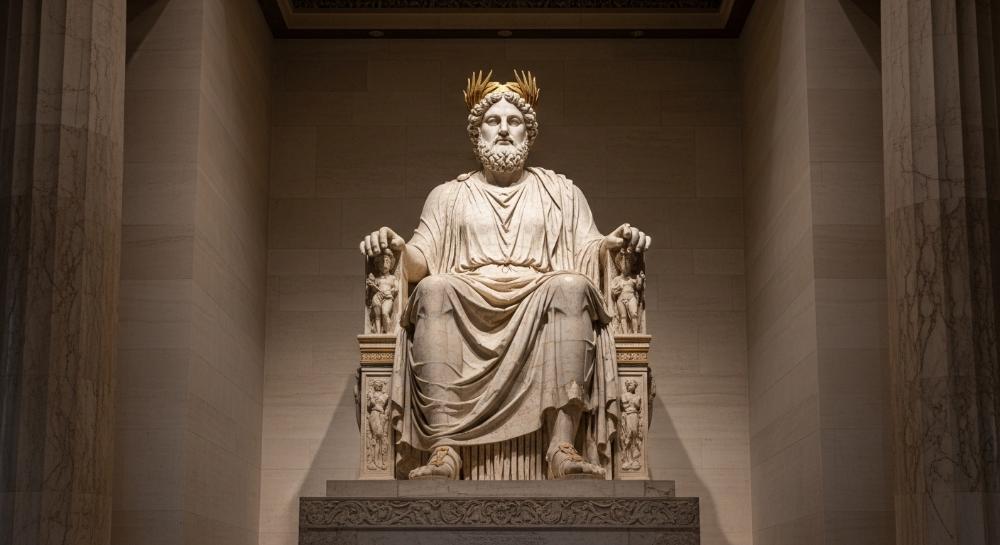
The statue survived for approximately 800 years before vanishing into history, likely destroyed by fire in the 5th century CE, either in Olympia itself or after being transported to Constantinople.
When you visit modern Olympia, about 3 hours from Athens, you won’t find Zeus waiting for you, but the journey is still absolutely worth making. The ruins of the Temple of Zeus remain, and walking among those toppled columns, you can trace the temple’s footprint and imagine where the great statue once sat.
4. Temple of Artemis at Ephesus, Turkey
Dedicated to the Greek goddess of hunting, Artemis, the Temple at Ephesus used to be a monumental structure that once stood in what is now Turkish territory. The temple was renowned for its grandeur, with marble columns, intricate friezes, and a sense of sacredness that attracted pilgrims and travelers from distant lands.

The date of construction is estimated at 550 BC. The legend tells that the final destruction happened through arson at the hand of a man named Herostratus.
Location: Ephesus, one of the prominent cities of the Greek empire, lies on the territory of modern Turkey, near the popular resort of Izmir, about 80 km away from the shore. There are no traces of the temple itself, but Ephesus, one of the biggest and oldest archaeological sites in the modern world, is definitely worth visiting.
Once an important Roman metropolis and the capital of Asia Minor. Today, Ephesus is an open-air museum. Wandering through Ephesus, you’ll encounter grand structures like the Library of Celsus, a piece of Roman architecture.
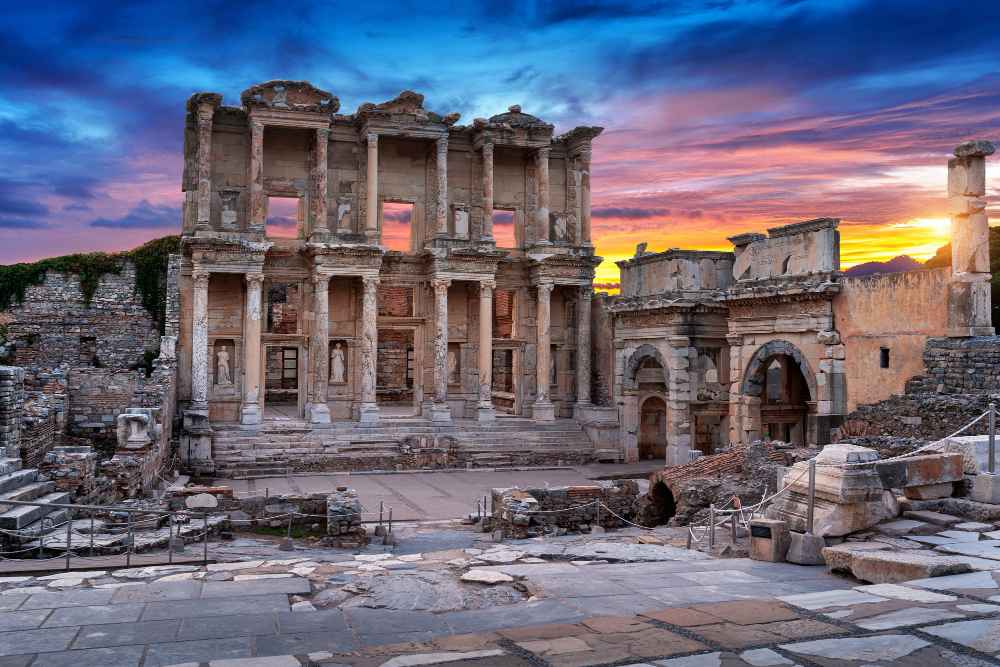
The Great Theatre, with its capacity to hold 25,000 spectators, echoes with the cheers of the past. The Odeon, being of a much smaller capacity, only 1,500, still hosts concerts nowadays.
Ephesus used to be a major hub for trade and culture back in its heyday. It featured all the amenities of a bigger city in the ancient world, like paved streets, aqueducts, and public baths.
5. Mausoleum at Halicarnassus, Turkey
The word “mausoleum” comes directly from this monument. Mausolus, the satrap of Caria, died around 353 BCE, and his wife and sister Artemisia II commissioned a tomb so extraordinary that it gave its name to every grand burial structure built afterward. It stood about 45 meters tall in what is now Bodrum, Turkey, and combined Greek, Egyptian, and Lycian architectural elements in a way that had never been done before.
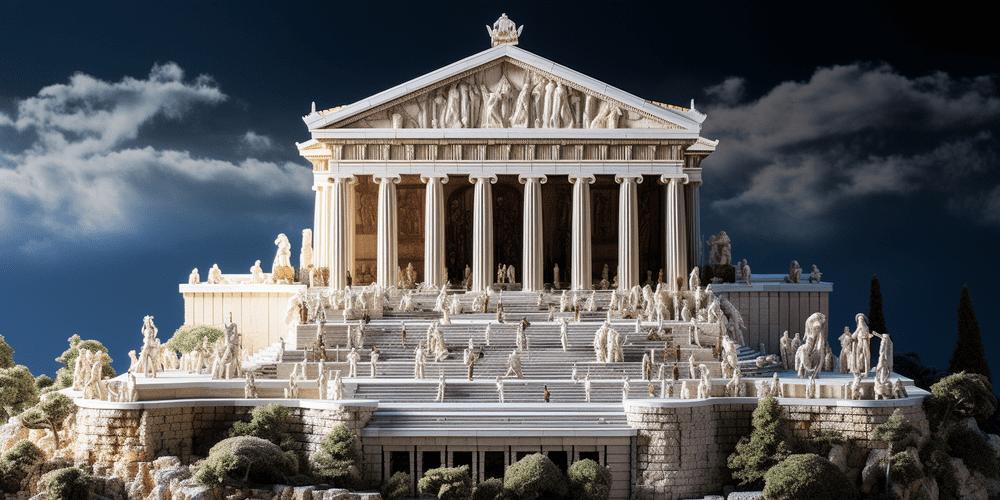
The tomb sat on a massive rectangular podium, topped with 36 Ionic columns, and finished with a 24-step pyramid and a marble quadriga (four-horse chariot) carrying statues of Mausolus and Artemisia. 4 of the greatest sculptors of the age, Scopas, Bryaxis, Leochares, and Timotheus, each carved one side of the building’s friezes.
Earthquakes between the 12th and 15th centuries dismantled most of what remained. The Knights of St. John finished the job in the 15th century, pulling the Mausoleum’s marble blocks to build Bodrum Castle.
Visiting the Mausoleum at Halicarnassus Today
The Mausoleum site sits in a quiet residential part of Bodrum. It’s open to the public, and you can walk down into the foundation area, see massive base stones, and read the on-site information. It takes about 45 minutes.
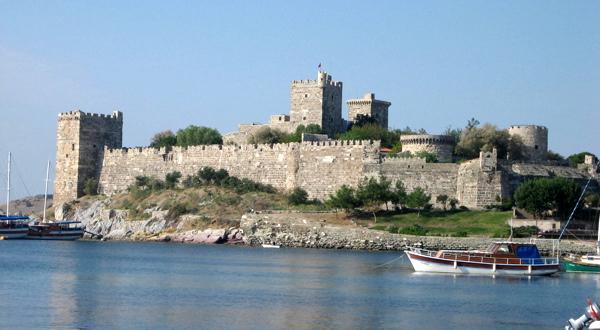
The real story of what was recovered is split between 2 places:
- Bodrum Castle (Castle of St. Peter): The castle walls contain marble fragments and stone blocks that came directly from the Mausoleum. The castle also houses an excellent Underwater Archaeology Museum.
- British Museum, London: Holds the most important sculptures from the site, including a statue widely identified as Mausolus himself, over 10 feet tall, and sections of the Amazonomachia frieze.
6. Colossus of Rhodes, Greece
The Colossus of Rhodes had a shorter life than any other wonder on this list. The bronze statue of the sun god Helios was completed around 280 BCE, stood roughly 33 meters tall, and was gone by 226 BCE when an earthquake snapped it at the knees. It stood for about 54 years. The wreckage lay on the ground for another 800 years before being sold for scrap by Arab invaders in 654 CE.
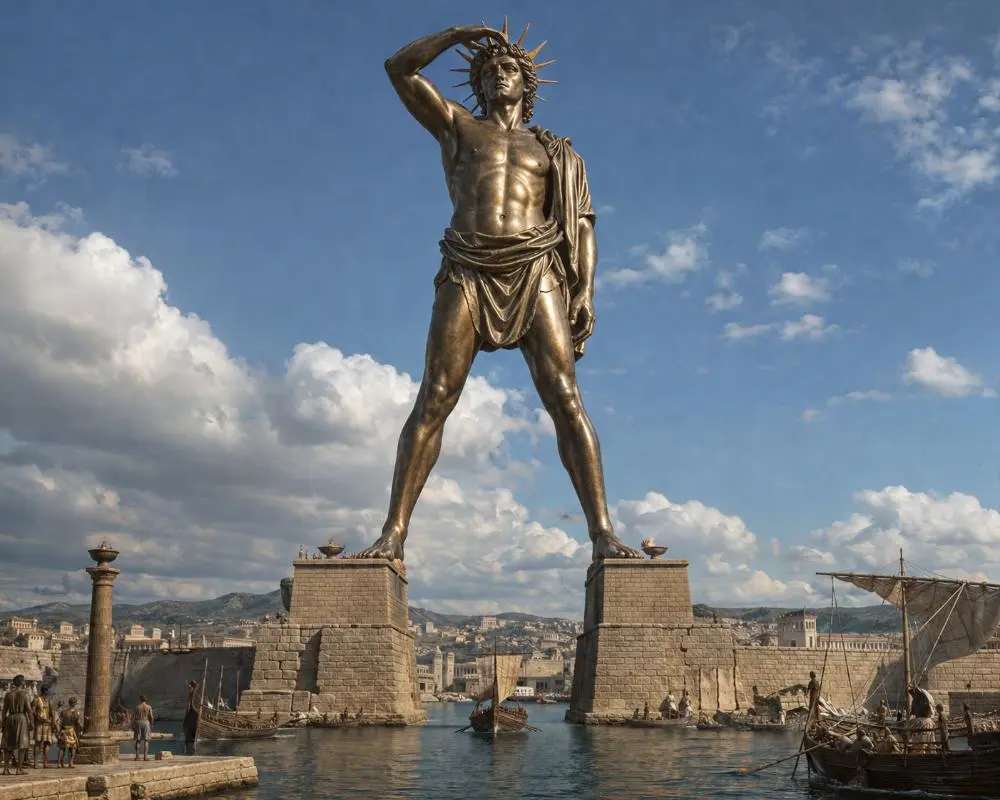
No physical remains survive. The popular image of the statue straddling the harbor entrance is almost certainly a Renaissance invention. Modern historians believe it stood to one side of Mandraki Harbor on a single pedestal.
The sculptor, Chares of Lindos, used an iron skeleton weighted with stone and covered with cast bronze plates. The sculptor Auguste Bartholdi credited descriptions of the Colossus as inspiration for the Statue of Liberty, including the solar crown and the raised torch.
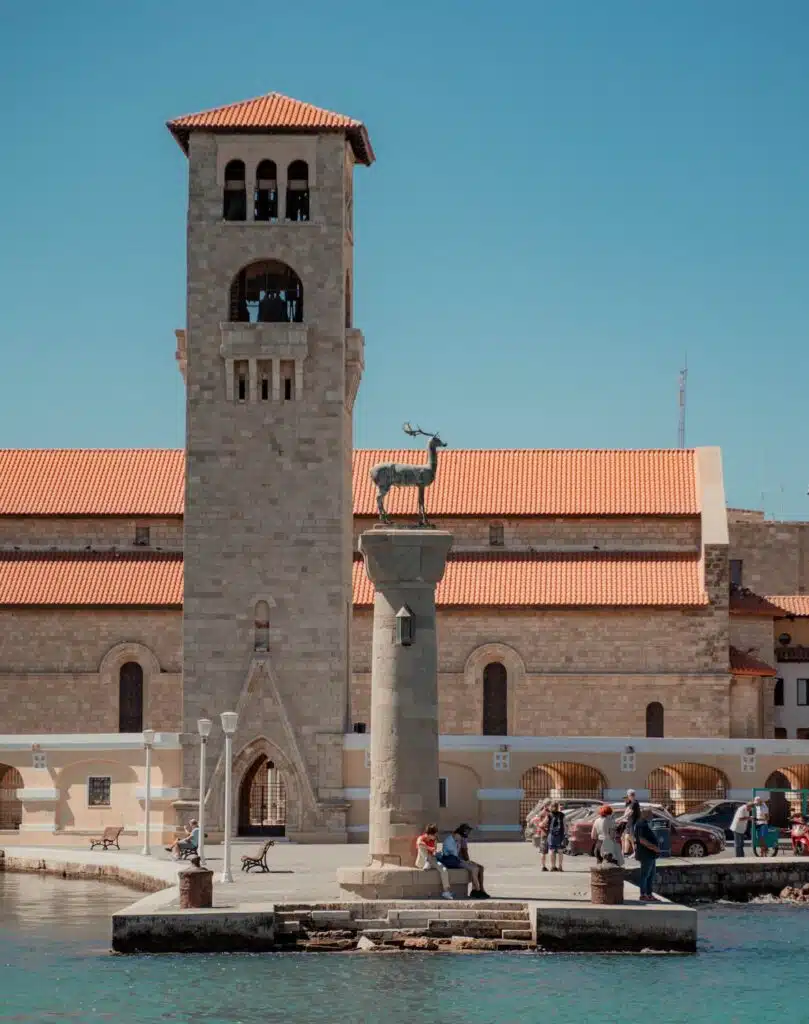
Location: Unlike the previous 4 wonders that live only in memories, Colossus does have some remnants. They are located on the picturesque island of Rhodes, washed by the 3 oceans. But instead of a gigantic statue of the god of the sun, there are smaller statues of deer framing the harbor at the northernmost point of the island
As mentioned before, Greece hosts 2 of the 7 original wonders of the world. And Rhodes is definitely a place you don’t want to miss on your trips to Greece. Its Old Town is a UNESCO World Heritage Site.
7. Lighthouse of Alexandria, Egypt
The Lighthouse of Alexandria, also known as the Pharos of Alexandria, was a towering lighthouse that guided sailors to the city’s harbor. It stood over 100 meters tall, adorned with a statue of Zeus or Poseidon at its summit.
The open top of the lighthouse housed a large curved mirror, reflecting sunlight by day and firelight by night. Mariners reportedly saw this light from up to 35 miles away. As legend has it, the light’s intensity was enough to burn enemy ships.
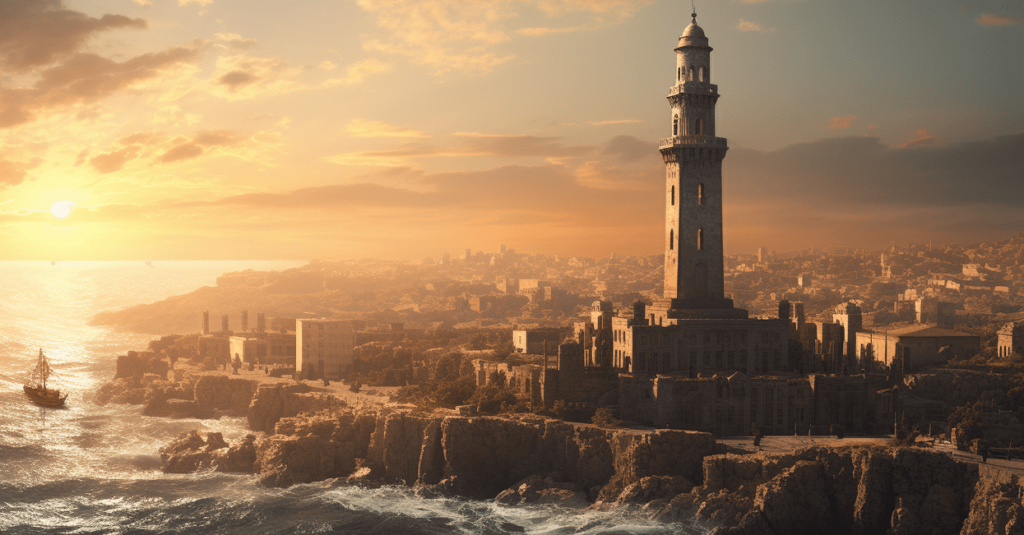
An interesting fact is that in many languages, the word ‘lighthouse’, like ‘phare’ or ‘faro’, is derived from the name of the island on which the Lighthouse of Alexandria stood. Unfortunately, the building and the island are gone now.
Location: The Lighthouse of Alexandria used to be a Burj Khalifa of the ancient world, being the tallest building for many centuries. The island on which it stood was submerged, and the remnants of the lighthouse are still found in the Mediterranean Sea.
Which of the 7 wonders of the world are in Turkey?
Temple of Artemis at Ephesus and the Mausoleum at Halicarnassus are in modern Turkey, however, there’s almost nothing to see today
What are the old 7 wonders of the world?
The Pyramid of Giza, Temple of Artemis at Ephesus, Mausoleum at Halicarnassus, Hanging Gardens of Babylon, Statue of Zeus, Colossus of Rhodes, Lighthouse of Alexandria
What is Mausoleum at Halicarnassus country?
Once ancient Greek city of Halicarnassus is situated in Bodrum, modern-day Turkey
Which of the 7 wonders of the world were in Greece?
Statue of Zeus at Olympia and the Colossus of Rhodes
What was the first 1 of the 7 wonders of the world?
The Pyramid of Giza is the oldest structure on the list and the only surviving one
When mausoleum at Halicarnassus was built?
It is believed to have been built in 350 BC
Who was Artemisia II of Caria?
Artemisia II was the queen of Caria and the wife of Mausolus
Which 7 wonders are in Egypt?
The Great Pyramid of Giza and Alexandria’s Lighthouse
For travelers who dive, this is one of the more unusual archaeological experiences available anywhere. Thousands of stone blocks, statues, and sphinxes from the lighthouse lie on the seabed near the citadel, at depths of about 8 to 10 meters.
- Visibility inside the Eastern Harbor is often 1 to 3 meters due to pollution and algae. Outside the harbor wall, it improves to around 10 to 12 meters.
- Water temperature runs around 15°C outside of summer, so a 5mm or 7mm wetsuit with a hood is necessary.
- What you’ll see: Massive granite blocks with sharp 90-degree edges intact after 2,000 years, fallen sphinxes, colossal statue fragments, and columns from multiple eras of repairs.
Documentaries to watch on the 7 Ancient Wonders of the World:
- Seven Wonders of the Ancient World (Bettany Hughes, 2025): Uses augmented reality to “rebuild” monuments on screen.
- Decoding the Great Pyramid (PBS NOVA, 2019): Investigates the precision engineering of the Giza Pyramid using new archaeological evidence and crew logbooks.
- Seven Wonders of the World (Apple TV, 1997): Focuses on the builders and construction techniques of each wonder.
- Ancient Egypt: Top 7 Pyramids (Prime Video/Apple TV, 2023): Explores why Giza and six other pyramids were exceptional engineering feats.
Read more
Pin this for later