There’s something almost irrational about wanting to climb a volcano. The sulfur smell, the unstable ground, the sheer scale of it.
- What to Know Before You Hike a Volcano
- Active, dormant, and extinct volcanoes
- How to read volcano alert levels
- The real risks on the trail
- Essential Safety Tips for Volcano Hiking
- Gear specific to volcanic terrain
- Tip
- Protecting yourself from volcanic gases
- Altitude and heat on volcanic summits
- Tip
- What to Pack for a Volcano Hike
- Top 15 Volcanoes to Hike Around the World
- 1. Mount Etna, Sicily, Italy
- 2. Volcán Villarrica, Chile
- 3. Bromo-Tengger-Semeru, Indonesia
- 4. Arenal Volcano, Costa Rica
- 5. Kīlauea, Hawaii, USA
- 6. Stromboli, Aeolian Islands, Italy
- 7. Pacaya Volcano, Guatemala
- 8. Mount Batur, Bali, Indonesia
- 9. Mount Erciyes, Cappadocia, Turkey
- 10. Mount Nyiragongo, DR Congo
- 11. Teide, Tenerife, Spain
- 12. Haleakala, Maui, Hawaii, USA
- 13. Mount Agung, Bali, Indonesia
- 14. Acatenango, Guatemala
- 15. Mount Vesuvius, Campania, Italy
- Beginner, Intermediate, and Advanced Volcano Hikes
- Which volcanoes require a guide
- Which volcanoes require advance permits
- Planning Your First Volcano Hike
- Read more
And yet, once you’ve done it, it’s one of those trips you talk about for years. This guide covers what you need to know to do volcano hiking safely, what to pack, and 15 of the best volcano hikes in the world across a range of difficulty levels.
What to Know Before You Hike a Volcano
Not all volcanoes are created equal, and the terminology matters more than you’d think. Before booking anything, it’s worth understanding the basic classification system, how to read alert levels, and what the actual hazards look like on the ground.
Active, dormant, and extinct volcanoes
An active volcano has erupted within the last 10,000 years or shows signs of activity right now. A dormant volcano hasn’t erupted recently, but could again. An extinct volcano has no realistic chance of erupting again based on its geological history. Hiking an active volcano like Stromboli, which erupts almost continuously, requires a very different approach than summiting an extinct one like Mount Erciyes in Turkey.
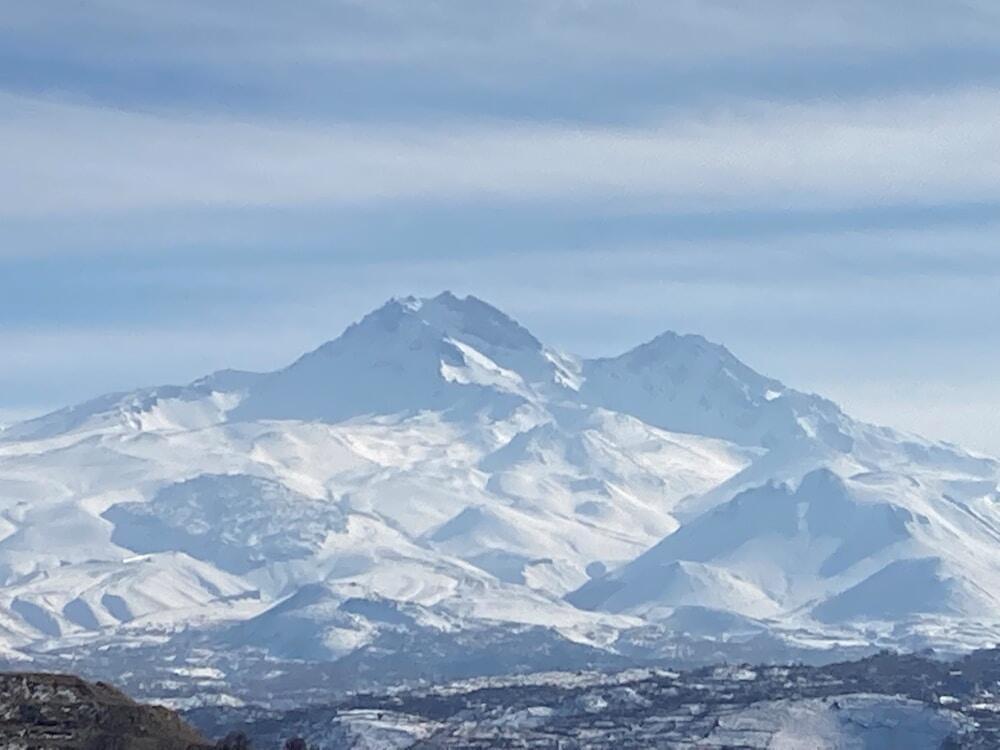
That said, “dormant” does not mean safe. Many dormant volcanoes still release gases, have unstable crater rims, and can shift alert status with little warning. Never assume a quiet volcano is a stable one.
How to read volcano alert levels
Most countries with active or dormant volcanoes publish real-time alert levels through official geological agencies. The scale varies by country but generally runs from Level 0 or Green (normal background activity) up to Level 4 or Red (major eruption in progress or imminent). In the US, the USGS Volcano Hazards Program monitors Hawaiian volcanoes. Italy uses INGV, Indonesia uses PVMBG, and New Zealand uses GeoNet.
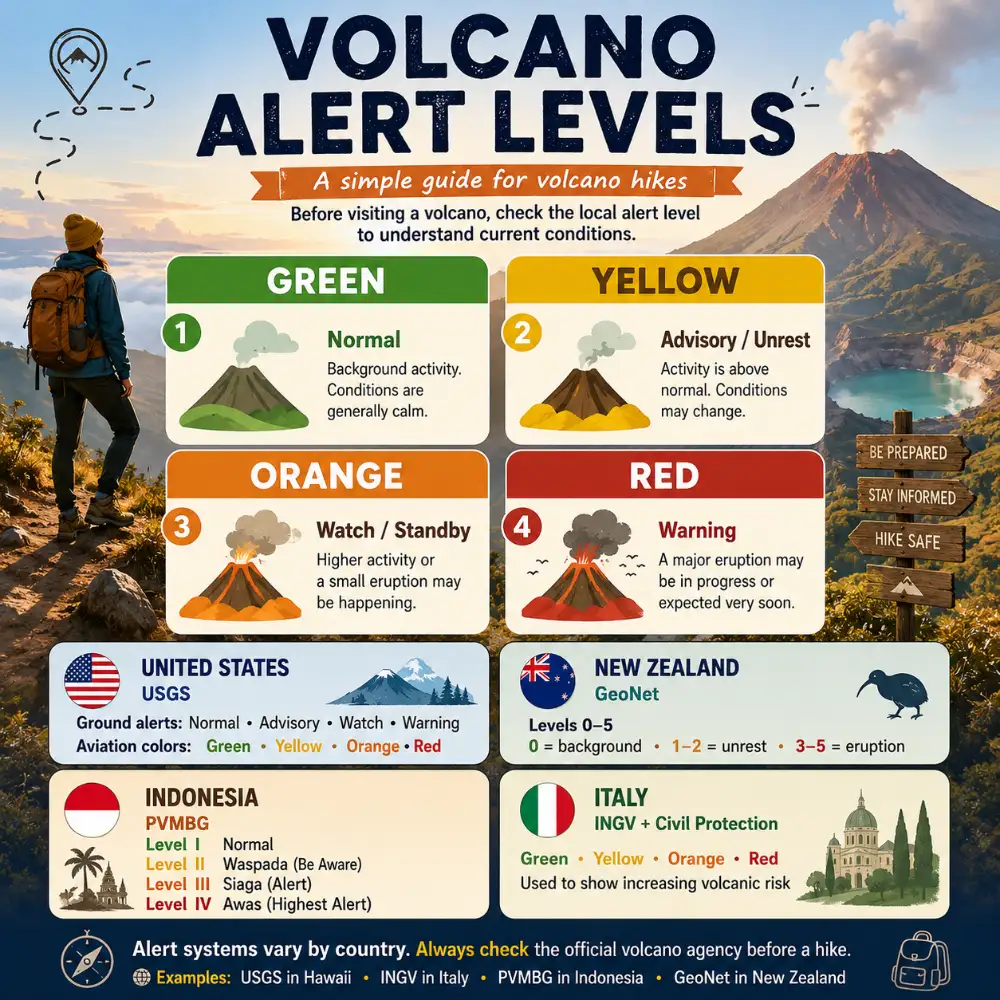
Before your hike, look up the specific volcano on that country’s monitoring agency site. A Level 1 or Green status is the minimum you want to see before going. If the volcano has moved to Level 2 in recent weeks, consider rescheduling. Most guided operators will cancel automatically if alert levels rise, but independent hikers need to check themselves.
The real risks on the trail
Volcanic gases are the most underestimated hazard. Sulfur dioxide (SO2) and hydrogen sulfide (H2S) collect in low-lying areas, craters, and fumarole fields, and in high concentrations they can incapacitate you within minutes.
Beyond gases, volcanic terrain is physically unforgiving: loose scree, razor-edged lava rock, steam vents hidden under crusted ground, and sudden weather changes at altitude. Flash flooding is also a real risk in tropical climates, where heavy rainfall can turn ash slopes into fast-moving lahar channels.
Essential Safety Tips for Volcano Hiking
Safety on a volcano is about preparation, not luck. The hikers who get into trouble are almost always the ones who underestimate the terrain, skip the gear, or ignore official warnings. Volcanoes have a few extra layers of risk that require a few extra layers of planning.
Gear specific to volcanic terrain
Standard hiking boots won’t cut it on sharp lava fields. You want sturdy, ankle-supporting boots with thick rubber soles that can handle abrasive surfaces. Many volcano trails involve scrambling over rough basalt or loose pumice slopes, so grip and ankle stability matter more than cushioning. Trekking poles are useful on steep descents where ash or gravel acts like loose sand underfoot.
Tip
Volcanic dust and ash will get into everything. Pack electronics in sealed bags, keep your camera lens covered until you’re shooting, and expect your boots to take a beating.
Eye protection is also a good idea near crater rims where ash and grit can blow unpredictably. Bright or reflective layers are worth packing too. Summit conditions change fast, and visibility can drop sharply in volcanic fog. If you’re hiking before dawn for a sunrise summit, as is common on Haleakala and Batur, you’ll want a solid headlamp and a backup.
Protecting yourself from volcanic gases
A standard face mask or bandana offers no meaningful protection against volcanic gases. If you’re hiking anywhere near active fumarole fields or a crater rim, a gas mask rated for SO2 and H2S is the right call. These are available online and at some outdoor gear stores. Nyiragongo, Stromboli, and Etna’s crater area are the environments on this list where you’d want one.
Even without a full gas mask, pay attention to your body. A burning sensation in your throat, watery eyes, or a sudden headache near a fumarole field means move upwind immediately. Stay out of crater depressions and valley-bottom areas where gases pool.
Altitude and heat on volcanic summits
Many of the world’s most hikeable volcanoes sit above 3,000 meters. Acatenango reaches 3,976m, Teide tops out at 3,718m, and Nyiragongo sits at 3,470m. At these elevations, altitude sickness is a real possibility if you’re flying in from sea level and heading straight up. If symptoms appear, descend.
Tip
On any volcano above 3,000m, spend at least one night at elevation before your summit day. It won’t fully prevent altitude sickness, but it meaningfully reduces your risk.
Heat is the counterintuitive risk. Volcanic terrain absorbs and radiates heat intensely, and many volcano hikes involve exposed ridgelines with no shade. Carry more water than you think you need: a minimum of 2 liters for a half-day hike, 3 to 4 liters for a full-day summit attempt. Electrolyte tablets are worth the weight on hot, exposed ascents.
What to Pack for a Volcano Hike
The packing list varies by destination and difficulty, but this covers the essentials for most volcano hikes. One practical note before you pack:
| Item | Notes |
|---|---|
| Sturdy ankle-support hiking boots | Thick rubber sole for lava terrain |
| Trekking poles | UV exposure increases sharply above the treeline |
| Headlamp + backup batteries | Required for pre-dawn summit hikes |
| Gas mask (SO2/H2S rated) | For active craters and fumarole fields |
| 3-4 liters of water | Increase for hot, exposed routes |
| Electrolyte tablets | Particularly important at altitude |
| High-SPF sunscreen | UV exposure increases sharply above treeline |
| Windproof and waterproof jacket | Summit weather changes fast |
| Warm mid-layer | Temperatures drop significantly at altitude |
| Wraparound sunglasses or goggles | Protects eyes from ash and grit |
| Snacks with fast carbs | Energy on long ascents |
| First aid kit with blister treatment | Lava rock destroys feet fast |
| Emergency whistle | Standard safety kit |
| Offline map downloaded | Cell signal is unreliable on most summits |
Top 15 Volcanoes to Hike Around the World
This list spans 6 continents and covers the full range of difficulty levels, from easy half-day walks to multi-day technical climbs. Each entry includes the key facts you need to decide if it belongs on your itinerary.
1. Mount Etna, Sicily, Italy
Etna is Europe’s most active volcano and one of the most accessible summit hikes on the continent. The standard route from Rifugio Sapienza takes you up to around 2,900 meters via cable car and 4×4 shuttle, with a guided walk to the upper crater area from there.
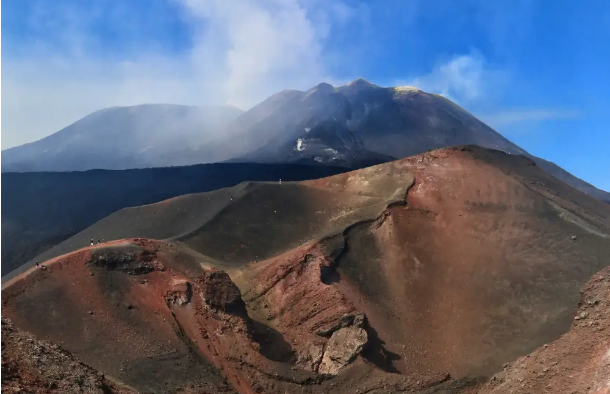
Independent hikers can go as far as the base of the summit cone without a guide. The terrain is dramatic: black lava fields, steaming fumaroles, and sweeping views across Sicily and the Tyrrhenian Sea.
Best season: April to November. No permit required.
2. Volcán Villarrica, Chile
Villarrica is one of the most beautiful volcano hikes in South America and one of the most technical on this list. The final section to the active crater at 2,847 meters requires crampons and ice axes on the snow-and-ice slope.
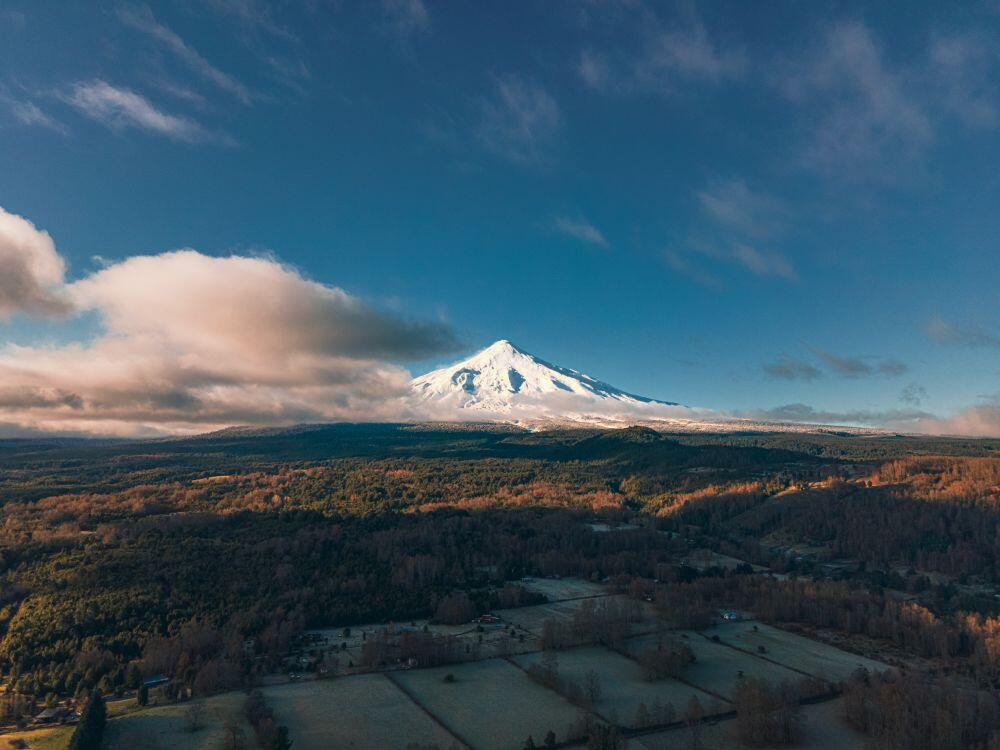
On a clear summit day, you can look directly into the lava lake below. A licensed guide is strongly recommended, and most operators in the nearby town of Pucon run organized ascents year-round.
Best season: November to March (Southern Hemisphere summer). No permit required, but a guide is strongly recommended.
3. Bromo-Tengger-Semeru, Indonesia
The Bromo Tengger Semeru National Park is one of the most otherworldly landscapes in Southeast Asia. Mount Bromo itself (2,329m) is accessible via a steep staircase from the Sea of Sand below, and the sunrise view over the caldera is consistently ranked among the best in the world.
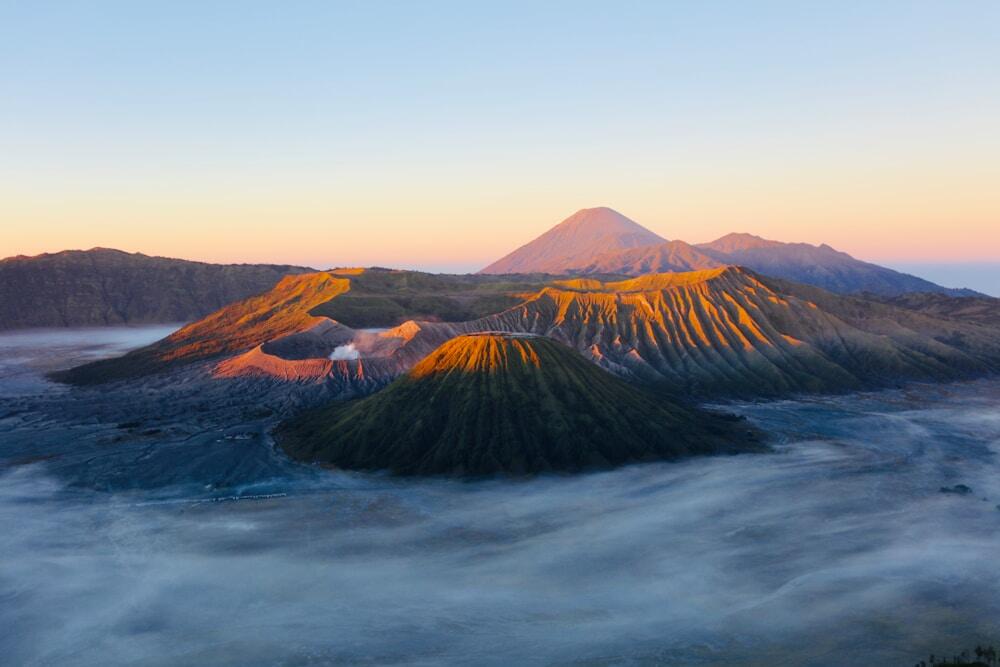
Most visitors arrive before dawn via jeep from the town of Cemoro Lawang. The park charges an entry fee (around $12 USD on weekdays), but no advance permit is required.
Best season: April to October (dry season). Entry fee only, no advance permit.
4. Arenal Volcano, Costa Rica
Arenal is the postcard volcano of Central America: a near-perfect cone rising 1,670 meters above the rainforest. It was highly active until 2010 and is now considered dormant, though still classified as active by volcanologists.
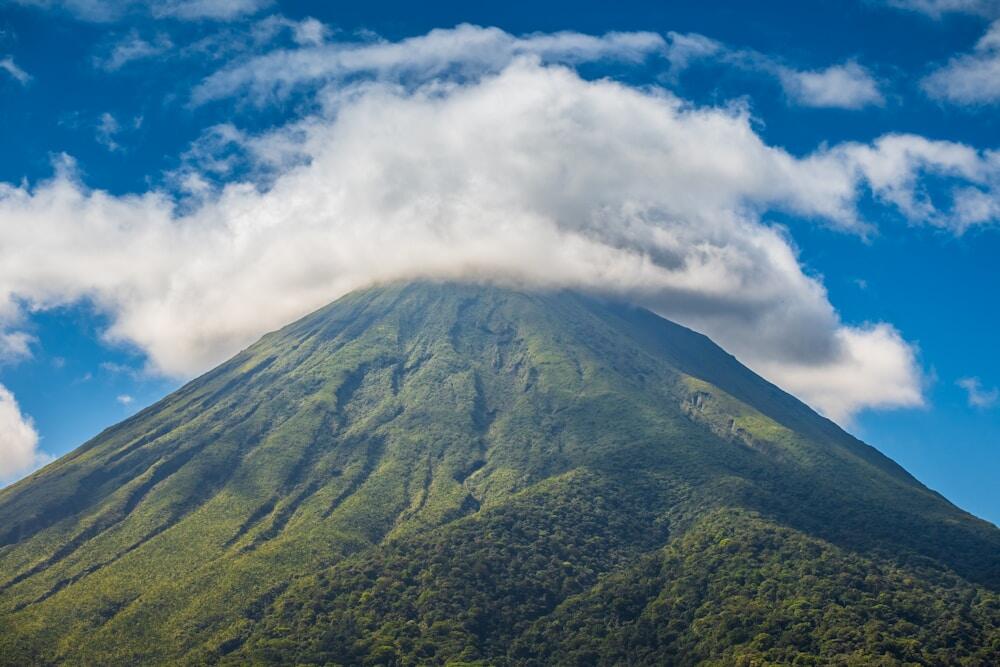
Hiking within Arenal Volcano National Park is restricted to designated trails, and you won’t reach the crater. The trails through hardened lava fields and cloud forest are genuinely excellent, and most people combine a visit with a night at one of the hot spring resorts in La Fortuna.
Best season: December to April (dry season). No permit required; park entry fee applies.
5. Kīlauea, Hawaii, USA
Kīlauea is one of the most active volcanoes on Earth and part of Hawaii Volcanoes National Park on the Big Island. The hiking here is unlike anywhere else: you can walk across cooling lava fields, peer into the Halema’uma’u Crater, and explore lava tubes.
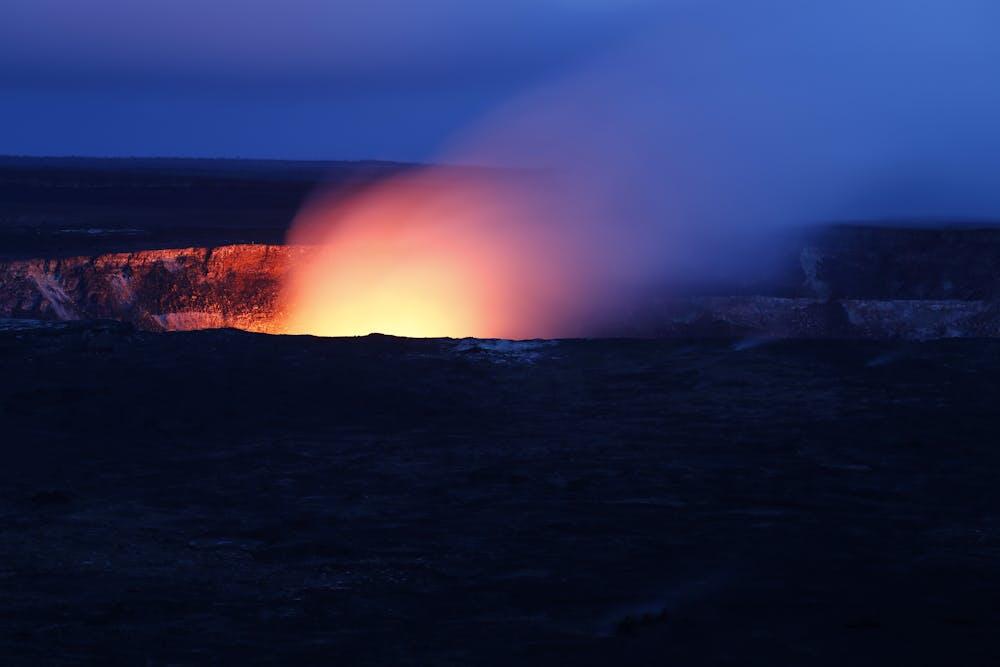
Trail access shifts depending on current eruption activity, so check the NPS site and USGS Volcano Hazards Program before you visit. No permit is required for general hiking in the park, though some crater-rim areas are periodically closed.
Best season: Year-round. No advance permit required; national park entrance fee applies.
6. Stromboli, Aeolian Islands, Italy
Stromboli earns its nickname “the lighthouse of the Mediterranean.” The volcano erupts roughly every 20 minutes, launching incandescent lava bombs from its crater in a display visible from miles out to sea.
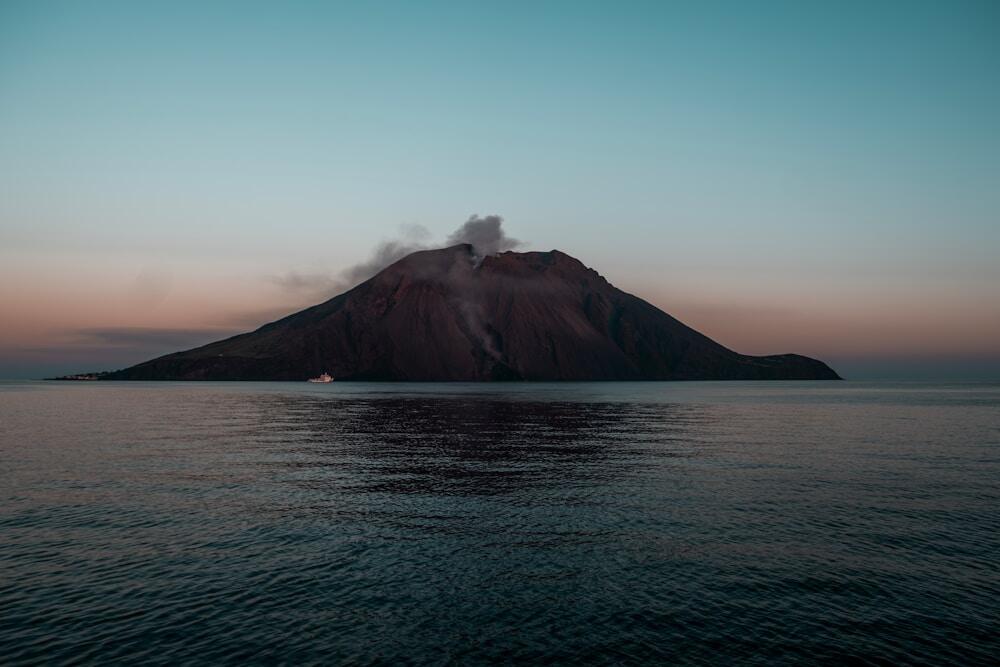
Hiking to the 924-meter summit is only permitted with a licensed guide, a regulation enforced strictly after a deadly eruption in 2019. The hike is timed so you reach the top at dusk, when the eruptions are most visible.
Best season: May to October. Guided hike mandatory; no separate permit required.
7. Pacaya Volcano, Guatemala
Pacaya is the most beginner-friendly active volcano on this list. At 2,552 meters, it’s a manageable 2 to 3-hour hike from the trailhead near San Francisco de Sales, about 2 hours from Antigua.
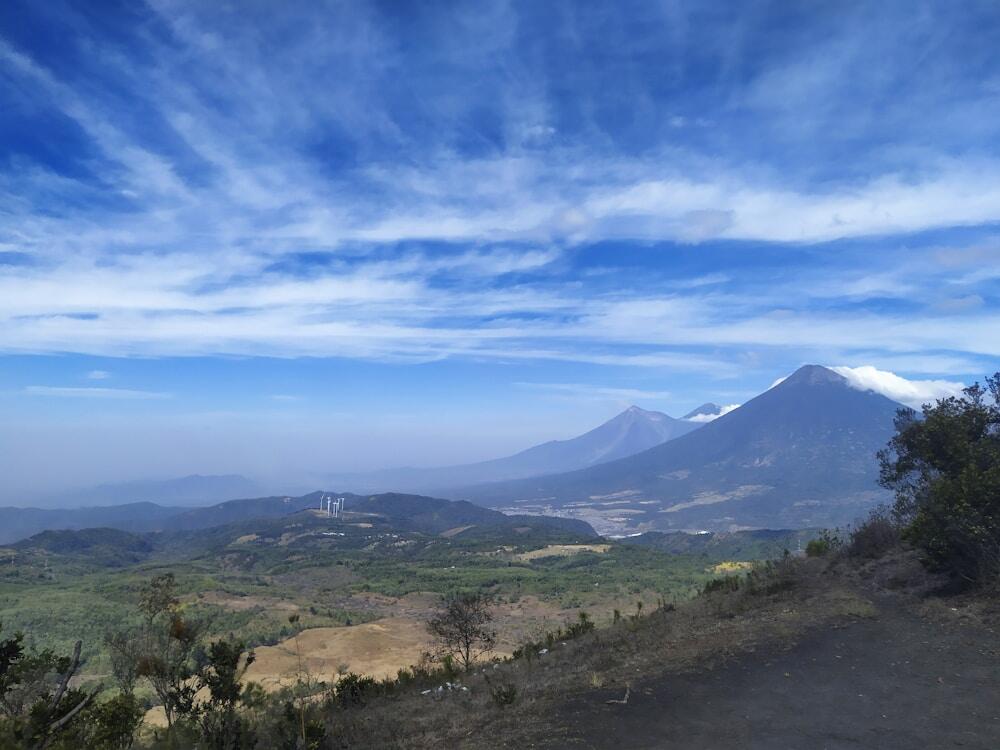
The upper section brings you within walking distance of active lava flows, and you can roast marshmallows directly on the hot ground (seriously, guides carry them). No permit or guide is mandatory, though local guides know the current lava flow situation better than any trail map.
Best season: Year-round. Park entry fee only, no advance permit.
8. Mount Batur, Bali, Indonesia
Mount Batur (1,717m) is Bali’s most popular volcano hike and one of the most rewarding pre-dawn climbs in Southeast Asia. The standard route starts around 2 AM and takes about 2 hours to the summit, arriving in time for sunrise over Lake Batur and Mount Agung.
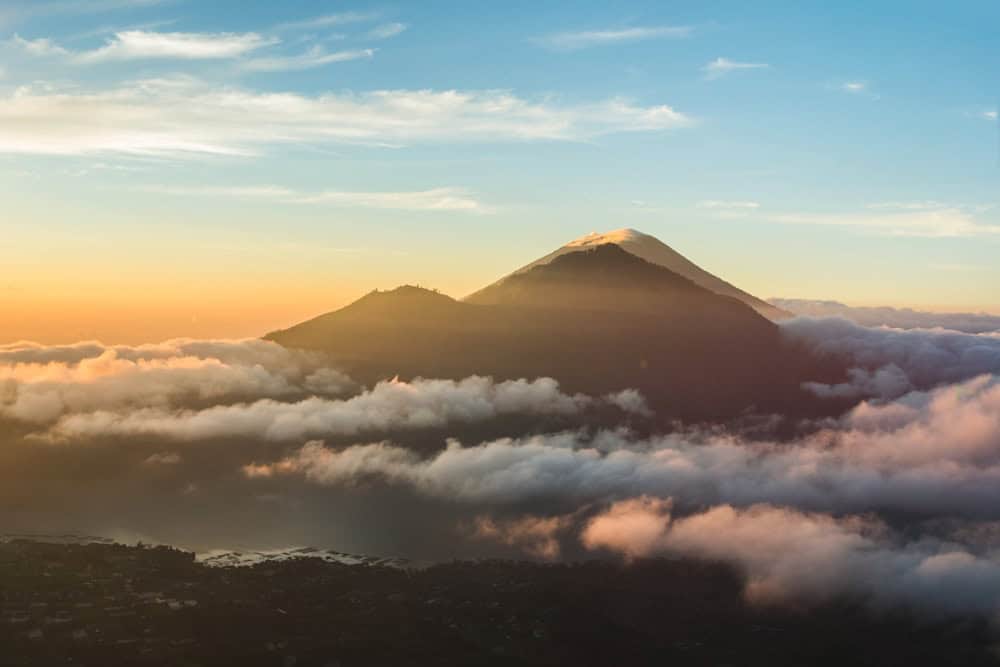
The local guide association requires all hikers to hire a registered guide, enforced at the trailhead. Guides include a basic breakfast at the summit, and no separate permit is needed beyond the guide fee.
Best season: April to October. Guide mandatory (included in standard trekking package); no separate permit.
9. Mount Erciyes, Cappadocia, Turkey
Erciyes (3,917m) is a stratovolcano that last erupted roughly 8,000 years ago and is classified as extinct. It towers over the Cappadocia plateau and offers one of the most underrated high-altitude hikes in Turkey.
The ascent is non-technical in summer months, though the upper section involves steep scree and snow patches that linger well into June. Views from the summit take in the surreal Cappadocian landscape below: fairy chimneys, ancient cave towns, and the broad volcanic plateau.
Best season: July to September. No permit required.
10. Mount Nyiragongo, DR Congo
Nyiragongo (3,470m) sits inside Virunga National Park and holds one of the world’s largest and most active lava lakes. The hike takes around 5 to 6 hours up, and most hikers overnight in metal cabins at the rim to see the lava lake glow at night.
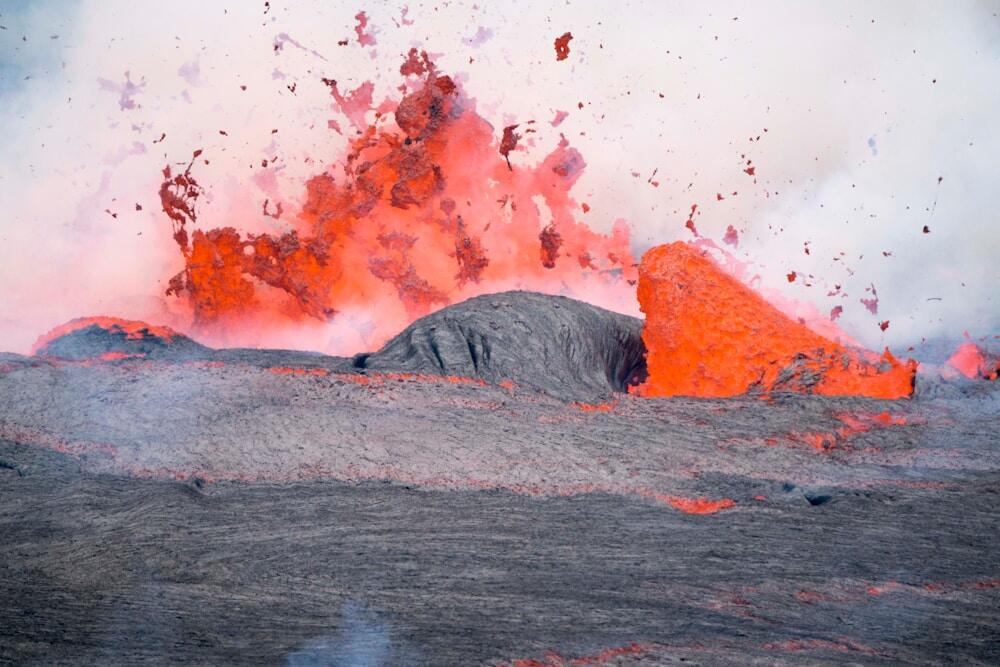
A permit via ICCN (the Congolese conservation authority) is mandatory and must be organized through a licensed tour operator. The park has had safety closures due to regional instability, so check current access conditions well in advance of any trip.
Best season: June to September and December to February. Permit via ICCN required, booked through a licensed operator.
11. Teide, Tenerife, Spain
Teide is the highest peak in Spain at 3,718 meters and the most visited national park in all of Europe. You can ride the cable car to 3,555 meters, but the final stretch to the summit requires a free permit limited to 200 people per day.
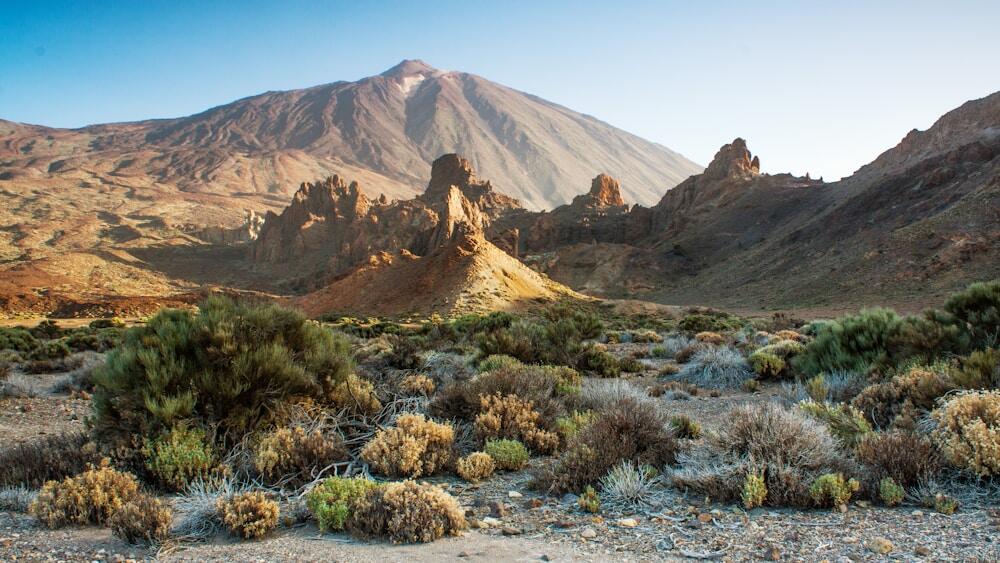
These permits are released 2 months in advance on the Teide National Park website and genuinely sell out. The walk from the cable car top station to the summit takes about 30 to 45 minutes on a marked path.
Best season: May to October. Summit permit required (free, limited to 200/day); book via Teide National Park website up to 2 months ahead.
12. Haleakala, Maui, Hawaii, USA
Haleakala (3,055m) is a shield volcano that forms most of eastern Maui, and its summit crater is one of the most alien landscapes in the United States. The sunrise from the summit is famous enough that a timed entry reservation is required via recreation.gov for vehicles arriving between 3 AM and 7 AM.
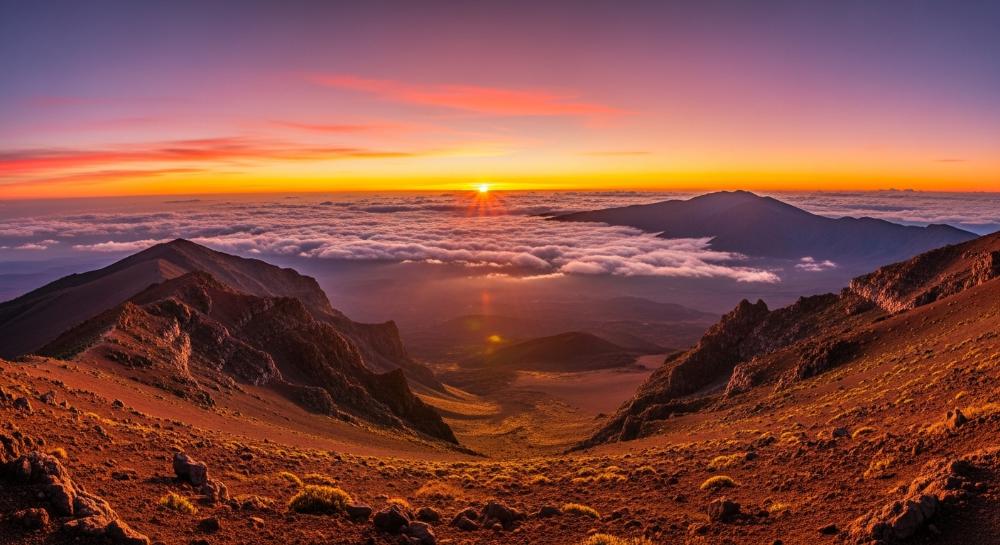
Hiking inside the crater is possible via the Sliding Sands Trail, which descends 600 meters into a landscape of cinder cones, silversword plants, and colored volcanic rock. The full crater traverse is a 19-kilometer overnight route requiring a separate backcountry permit.
Best season: Year-round (summit can be cold and foggy). Sunrise vehicle permit required via recreation.gov; backcountry permits required for overnight crater hikes.
13. Mount Agung, Bali, Indonesia
Agung is Bali’s highest and most sacred volcano at 3,031 meters. It last erupted in 2017 and 2019, so alert levels should be checked carefully before any attempt.
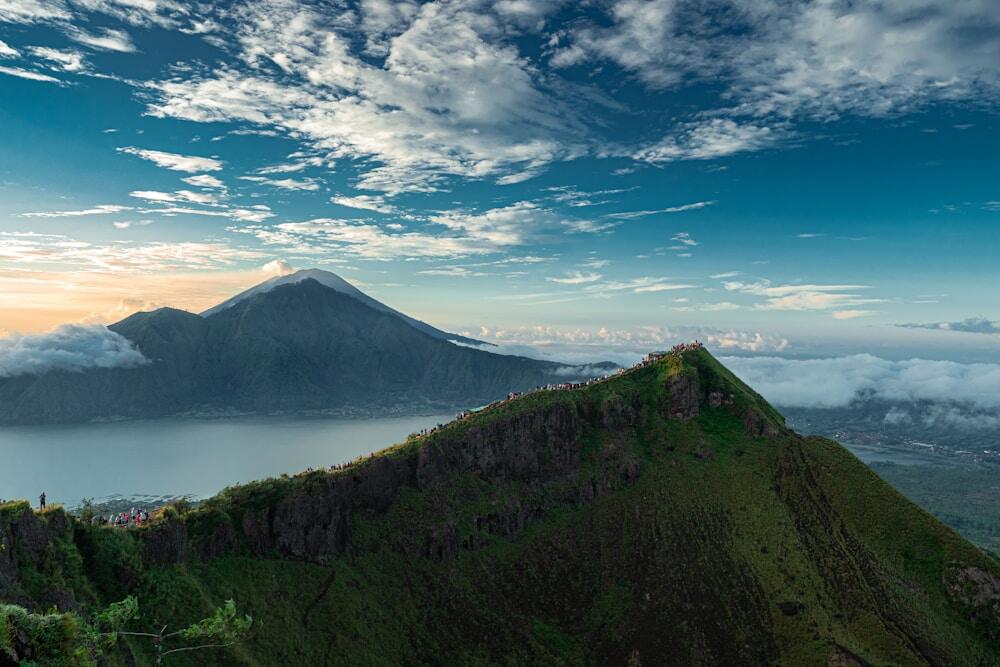
The standard route starts from Pura Pasar Agung temple, and both a temple access permit and a licensed guide are required. The summit crater is a narrow ridge with dramatic views over Bali, Lombok, and the surrounding sea.
Best season: April to October. Temple access permit required; guide mandatory.
14. Acatenango, Guatemala
Acatenango (3,976m) is the best overnight volcano hike in Central America. The standard route is a two-day, one-night climb with base camp on the saddle between Acatenango and the highly active Volcán de Fuego.
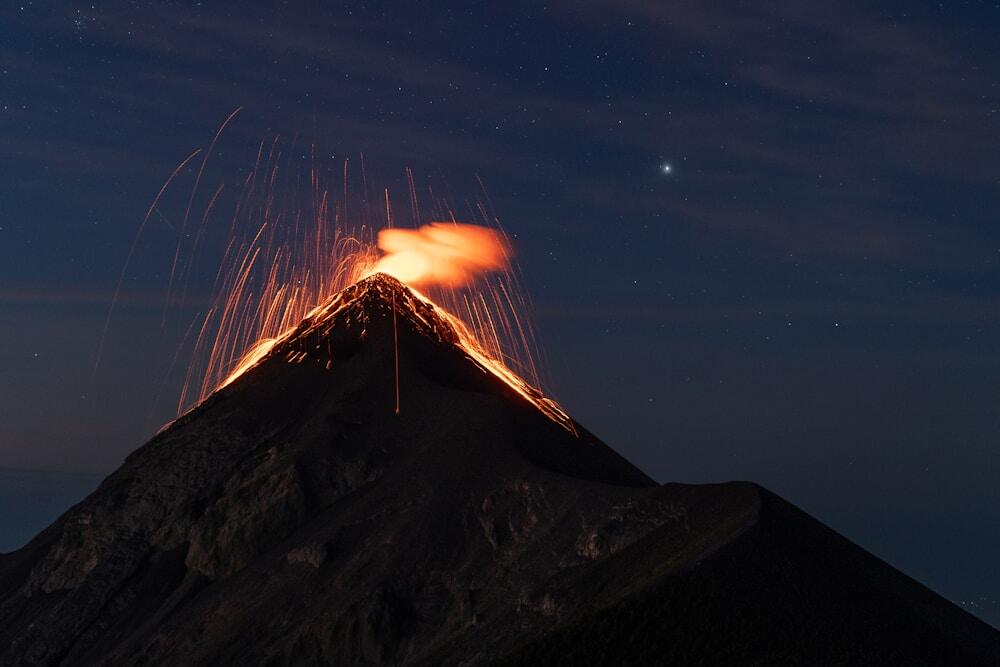
Watching Fuego erupt throughout the night from your tent is one of the most memorable experiences in adventure travel. No permit is required for independent hikers, but most people go with an operator who provides tents, sleeping bags, and meals for around $35 to $60 USD.
Best season: November to April (dry season). No permit required; guide strongly recommended.
15. Mount Vesuvius, Campania, Italy
Vesuvius (1,281m) is the only active volcano on mainland Europe, and the most historically loaded summit you can walk to.
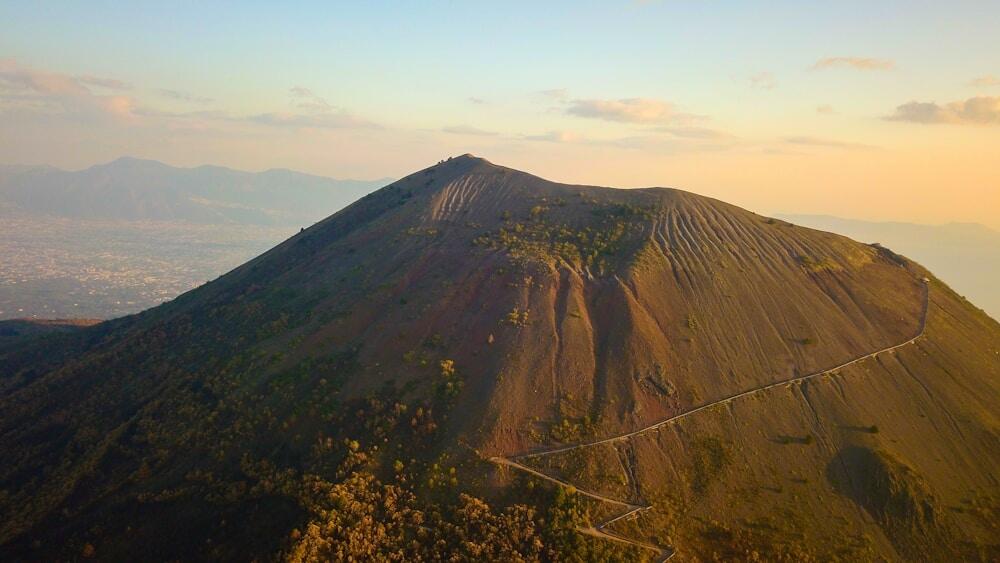
The crater trail starts from a parking area at 1,000 meters and takes about 30 minutes up a well-maintained path to the rim. From the top, you look directly into the crater and across the Bay of Naples to the ruins of Pompeii below.
Entry requires a ticket purchased at the site or online in advance; no guide is required.
Best season: Year-round. Entry fee required (purchased at the site or online); no advance permit needed.
Beginner, Intermediate, and Advanced Volcano Hikes
Here’s how all 15 destinations stack up by difficulty, guide requirement, permit status, and best hiking season.
| Volcano | Country | Difficulty | Guide Required | Permit Required | Best Season |
|---|---|---|---|---|---|
| Arenal | Costa Rica | Beginner | No | No (park fee) | Dec – Apr |
| Pacaya | Guatemala | Beginner | No | No (park fee) | Year-round |
| Mount Batur | Indonesia | Beginner | Yes | No (guide fee) | Apr – Oct |
| Vesuvius | Italy | Beginner | No | No (entry fee) | Year-round |
| Haleakala | USA | Beginner – Intermediate | No | Sunrise vehicle permit | Year-round |
| Bromo | Indonesia | Beginner – Intermediate | No | No (park fee) | Apr – Oct |
| Kīlauea | USA | Beginner – Intermediate | No | No (park fee) | Year-round |
| Teide | Spain | Intermediate | No | Yes (summit permit, free) | May – Oct |
| Mount Etna | Italy | Intermediate | No (crater area: yes) | No | Apr – Nov |
| Mount Agung | Bali | Intermediate – Advanced | Yes | Yes (temple permit) | Apr – Oct |
| Stromboli | Italy | Intermediate – Advanced | Yes (mandatory) | No | May – Oct |
| Acatenango | Guatemala | Advanced | Recommended | No | Nov – Apr |
| Villarrica | Chile | Advanced | Recommended | No | Nov – Mar |
| Mount Erciyes | Turkey | Advanced | No | No | Jul – Sep |
| Nyiragongo | DR Congo | Advanced | Yes (mandatory) | Yes (ICCN permit) | Jun – Sep, Dec – Feb |
Which volcanoes require a guide
Guide-mandatory hikes (you cannot legally or safely do these independently): Stromboli, Nyiragongo, Mount Batur, and Mount Agung. For Stromboli and Nyiragongo, this is a hard legal requirement. For Batur and Agung, it is enforced at the trailhead by local guide associations.
Guide strongly recommended but not mandatory: Villarrica and Acatenango. Both involve technical or high-altitude terrain where the margin for error is slim, and hiring a local guide on either is cheap relative to the risk of going without one.
Fully DIY-friendly: Etna (below the summit cone), Pacaya, Teide, Arenal, Bromo, Kīlauea, Haleakala, Vesuvius, and Erciyes.
Which volcanoes require advance permits
Permits that must be arranged before arrival:
- Teide, Spain: Free summit permit, limited to 200 people per day. Book up to 2 months in advance via the Teide National Park website. These genuinely sell out.
- Haleakala, USA: Timed entry vehicle reservation required for sunrise visits (3 AM to 7 AM) via recreation.gov. Backcountry overnight permits required separately for crater camping.
- Nyiragongo, DR Congo: Permit via ICCN, must be arranged through a licensed tour operator. Cannot be obtained independently on arrival.
- Mount Agung, Bali: Temple access permit required before the trailhead. Typically arranged by your guide or operator.
Entry fees only, no booking required: Etna, Arenal, Kīlauea, Bromo, Pacaya, Batur, Vesuvius, Acatenango, Villarrica, and Erciyes.
Planning Your First Volcano Hike
Start with the difficulty column in the table above to find your level, then look at permit and guide requirements to understand what planning each destination actually involves. The gap between a beginner volcano like Pacaya and an advanced one like Nyiragongo is significant in terms of logistics, fitness, and budget.
Knowing where you sit before committing to a destination will save you a rough experience on the mountain. If you’re new to volcano hiking, Pacaya, Batur, and Vesuvius are the 3 best starting points: all accessible, all genuinely dramatic, and none requiring months of advance planning.